Best Returns Management Software (2026): Top 10 Compared
Returns management software gives online retailers a portal to authorise returns, issue labels, offer exchanges and route returned items. The ten products below differ by merchant size and return model. Loop Returns, AfterShip Returns, ReturnGO, Rich Returns and Redo serve online merchants, most of them Shopify-focused, with published monthly plans or a free portal. ZigZag Global focuses on cross-border returns for UK and European retailers. Happy Returns offers in-person, box-free drop-off for high-volume US retailers, while Narvar and parcelLab place returns inside wider post-purchase platforms for large and mid-market retailers. ReverseLogix covers B2B, warranty and repair returns. Happy Returns, Narvar, parcelLab and ReverseLogix quote only.
Order is not a ranking. How entries are ordered.
On this page
Compare at a glance
Select a vendor for details and sources. Scroll the table horizontally on smaller screens.
| Vendor | Consider for | Pricing notes | Standout |
|---|---|---|---|
| Loop Returnsmid-market | Shopify brands wanting an exchange-first returns portal | Checkout+ free; Essential from $155/mo; Advanced from $340/mo Checked Sep 2026 | Instant Exchange, Shop Now and Bonus Credit steer shoppers from refunds |
| AfterShip Returnssmb | Small and growing stores wanting a low published entry price | Essentials from $16/mo (240 returns/yr); Premium from $99/mo (1,200/yr); Enterprise custom; annual 18% off Checked Sep 2026 | Labels across 68 carriers, printerless QR drop-off, Happy Returns support |
| ReturnGOmid-market | Mid-sized brands wanting returns, exchanges, coverage and labels in one tool | Premium from $147/mo; Pro from $297/mo; Enterprise quote-based Checked Sep 2026 | Return Coverage shifts return costs to shoppers |
| Rich Returnssmb | Small Shopify merchants with low return volumes | Standard $19/mo; Professional $39; Premium $99; Enterprise from $199/mo; yearly up to 20% off Checked Sep 2026 | Four priced tiers with a 30-day free trial |
| ZigZag Globalspecialist | UK and European retailers with cross-border returns | Shopify app: Free (UK domestic); Silver £20/mo; Gold £50/mo; Enterprise by demo Checked Sep 2026 | 1,500+ carrier services in 170+ countries, customs handled |
| Redosmb | Shopify brands wanting a free portal with no contract | Portal free, labels covered by Redo; AI agents and international returns quoted Checked Sep 2026 | Shared return hubs in five regions with licensed customs brokers |
| Happy Returnsenterprise | US retailers with high volumes wanting box-free in-person returns | Quote-based; Return Bar pricing varies by volume and product type Checked Sep 2026 | Nearly 10,000 Return Bar locations, items verified at drop-off |
| Narvarenterprise | Large retailers wanting returns inside a wider post-purchase platform | Quote-based; returns page routes to a demo Checked Sep 2026 | Shield scores return fraud risk with the IRIS AI layer |
| parcelLabenterprise | Enterprise and mid-market retailers, especially in Europe | Quote-based; no price list published Checked Sep 2026 | Email, SMS and WhatsApp return notices with RMA export to the warehouse |
| ReverseLogixenterprise | Manufacturers and brands with B2B, warranty or repair returns | Quote-based; no price shown Checked Sep 2026 | B2B bulk returns with entitlement checks and repair workflows |
These comparisons draw on public product information, not hands-on testing of every tool. Source records identify available references and checks; missing evidence is marked. Buyer fit is an editorial assessment, not a measured performance score. How to use this research.
Video overview
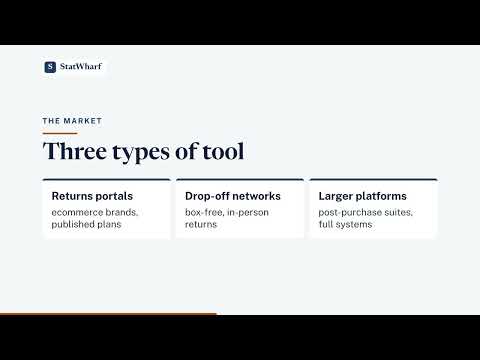
A two-minute overview of the category: what these tools do, the main product types, how pricing works and what to check before signing. Watch on YouTube.
Returns management software handles product returns for online and omnichannel retailers. It gives shoppers a self-service portal, applies the merchant’s return policy, issues labels or drop-off codes, steers customers toward exchanges or store credit, and tracks each item back to the warehouse. The aim is to cut the cost of returns, keep revenue that would otherwise be refunded, and reduce support contacts. Buyers also search for it as a returns platform, returns portal or reverse logistics software.
The ten products compared here fall into three groups. Loop Returns, AfterShip Returns, ReturnGO, Rich Returns, ZigZag Global and Redo sell returns portals aimed mainly at ecommerce brands, most with published monthly prices or free tiers. Happy Returns adds a physical drop-off network in the United States. Narvar, parcelLab and ReverseLogix serve larger retailers and brands, either inside a wider post-purchase platform or as a full returns management system that covers warehouse processing, repair and warranty. All pricing notes were checked in September 2026. Entries with dated source checks appear first. That order records research readiness. It is not a measure of product quality or a ranking.
Related pages cover order management software, ecommerce fulfillment companies and shipment tracking software.
Vendor details and trade-offs
Loop Returns began as a returns app for Shopify merchants and now describes itself as a post-purchase operations platform covering tracking, order editing, returns, exchanges, fraud prevention and shipping. Returns remain the core product. The vendor states that Shopify brands can go live out of the box, while merchants on other ecommerce platforms are supported through custom implementations that take longer.
The returns product is a self-service portal with a rules engine behind it. Merchants set return policies by region, warehouse and product, control which items can be returned and where they go, and let the system approve returns automatically. Two-way integrations with help desk and warehouse tools let approval happen without staff switching systems. Loop Intelligence, the vendor's fraud layer, scans each return for abnormal behaviour and alerts the merchant team rather than blocking the shopper outright.
Exchanges carry much of the product's positioning. The vendor offers variant exchanges, advanced exchanges, Shop Now (shopping the catalogue during the return), Instant Exchange and Bonus Credit to keep revenue in the store. Shipping options include multiple global carriers, printerless returns, in-person drop-off at the merchant's stores through point of sale, and box-free returns through partners such as Happy Returns. Loop reports more than 100 million returns processed, a vendor-reported figure.
The pricing page lists three tiers. Checkout+ is listed as free and includes returns software, US and Canada domestic return labels and Return Bars. Essential starts at $155 a month and adds unlimited destinations, automated return policies, carrier rate shopping and workflows. Advanced starts at $340 a month and adds Shop Now, Instant Exchange, Bonus Credit and fraud prevention.
Potential strengths
- Published starting prices for the Essential and Advanced tiers
- Integrates with Happy Returns for box-free drop-off and with point-of-sale systems for in-store returns
Trade-offs
- Built for Shopify first; other platforms need a custom implementation with longer timelines, according to the vendor
- Several revenue-retention features, including Instant Exchange and Shop Now, sit only in the Advanced tier
- Product reference
- Pricing source
- Billing terms: Per month (as listed on the pricing page)
- Source review: checked Sep 20, 2026
- Vendor confirmation: not confirmed
AfterShip is best known for shipment tracking, and AfterShip Returns is its separate returns and exchanges product. The product page positions it around three goals: recapturing revenue through exchanges, cutting returns-related costs and improving the shopper experience. Exchanges support Shopify and Stripe Checkout.
Policy automation is a large part of the offer. Merchants can set conditional resolutions, enforce eligibility by price, category, condition or days since purchase, stack routing rules and create rules for multiple or bulky items. On the logistics side, AfterShip generates return labels with 68 carriers worldwide and supports printerless QR code drop-off at carriers such as FedEx, USPS, Royal Mail and Canada Post. It also supports more than 9,000 Happy Returns Return Bars in the United States. RMA creation, advance shipping notices and item receipt can be automated with 3PL systems.
The pricing page publishes three plans and scales prices by return volume. At the lowest volume setting, Essentials starts at $16 a month for 240 returns a year, with $0.50 per extra return. It includes a branded returns page, refunds and exchanges, automatic labels, eligibility and basic routing rules, automatic approval, analytics, store credit and three carrier accounts. Premium starts at $99 a month for 1,200 returns a year, with $1.00 per extra return. It adds advanced workflows, AI-powered exchanges, fraud detection, integrations with tools such as Klaviyo, Gorgias and NetSuite, an API, a warranty claims portal and point-of-sale returns. Enterprise is custom-priced and adds custom API rate limits, workflows and integrations. Annual billing is shown at 18% off.
Potential strengths
- The lowest published entry price among the portal vendors on this page
- RMA creation, advance shipping notices and item receipt automation with 3PL systems
Trade-offs
- Tier prices scale with annual return volume, so the headline price applies only to low volumes
- Fraud prevention, AI exchanges and ERP or WMS integrations start in the Premium tier
- Product reference
- Pricing source
- Billing terms: Monthly or annual; annual shown at 18% off
- Source review: checked Sep 20, 2026
- Vendor confirmation: not confirmed
ReturnGO sells a post-purchase platform with returns and exchanges at its centre. The vendor describes it as an open platform built to integrate with any ecommerce stack, including 3PL, ERP, help desk and loyalty tools, and it connects to existing shipping carriers or aggregators.
The product is split into five parts. Return Coverage lets a merchant charge shoppers for return protection, which shifts the cost of returns away from the business and can create a new revenue line. Shipping provides forward and return labels from major carriers, with multi-carrier options. Tracking and Notifications sends branded order updates for any shipment to reduce support contacts. Returns covers the self-service portal and its resolution options. Exchanges lets shoppers swap items directly, with Shop Now incentives that make the exchange work like a shopping session.
ReturnGO reports 39% retained revenue, a $1.95 increase in revenue per return and $3.40 in logistics costs saved per return. These are vendor-reported figures.
The pricing page publishes two self-service tiers. Premium starts at $147 a month and covers the self-service returns and exchanges experience. Pro starts at $297 a month and adds deeper integration with the merchant's ecommerce stack. Enterprise is quote-based and combines operational tools, returns, exchanges and order tracking. A 14-day free trial applies only to Shopify self-service plans. The vendor states that Shopify implementation takes one to three days if third-party integrations are already in place, and that other platforms may take longer.
Potential strengths
- Published starting prices for two self-service tiers
- The vendor states Shopify implementation takes one to three days when third-party integrations are already in place
Trade-offs
- The Shopify self-service app does not include all Enterprise features, according to the vendor
- Some features depend on the limitations of each ecommerce platform
- Product reference
- Pricing source
- Billing terms: Per month (as listed on the pricing page)
- Source review: checked Sep 20, 2026
- Vendor confirmation: not confirmed
Rich Returns is a returns and exchanges app aimed mainly at Shopify merchants. Its feature list is built around Shopify: synchronisation with the store, Shopify Return Sync, a Shopify Shop Mini, and support for pausing or resuming subscriptions during a return.
The entry tier covers the basics. Merchants get a branded returns portal, automated prepaid labels, automatic return approval and customer emails in multiple languages, plus six integrations. The Professional tier adds a resolution hub, variant exchanges, an advanced analytics dashboard, a multilingual portal and return reasons, language customisation and CSV export. The Premium tier adds advanced exchanges, automated refunds, automatic exchange orders, automated store credit, advanced rules and trend reports. The Enterprise tier is described as suited to merchants who ship internationally, and adds international labels, a custom domain, QR code labels, an audit log, API access, automatic tracking, store-wide exchanges and more advanced rules.
Pricing is published in full. Standard costs $19 a month and includes 10 returns a month, with $1 for each extra return. Professional costs $39 a month for 50 returns, with $0.75 per extra return. Premium costs $99 a month for 100 returns, with $0.50 per extra return. Enterprise starts at $199 a month and is aimed at merchants handling more than 500 returns a month. Yearly billing saves up to 20%, and each plan can be tried free for 30 days.
Because included allowances are small, a merchant should calculate cost at its actual monthly return count. A store with 300 returns a month on Premium, for example, would pay overage on 200 of them under the published terms.
Potential strengths
- Every tier, including Enterprise, has a published starting price
- Shopify synchronisation, Shopify Return Sync and a Shopify Shop Mini are listed features
Trade-offs
- Included return allowances are small, so overage fees matter for growing stores
- Automated refunds, automatic exchange orders and store credit start at the Premium tier
- Product reference
- Pricing source
- Billing terms: Monthly or yearly; yearly shown at up to 20% off
- Source review: checked Sep 20, 2026
- Vendor confirmation: not confirmed
ZigZag Global is a UK-based returns company that says it pioneered digital returns more than a decade ago. It combines returns software with a returns carrier network, which sets it apart from portal-only vendors. The vendor states that its network covers more than 1,500 carrier services in more than 170 countries, with over 500,000 drop-off locations, and that it handles customs for international returns. It reports that £2 billion worth of returns passed through the platform in the last year. These are vendor-reported figures.
Beyond the portal, ZigZag sells several related services. Tracking pages and carrier claims handling sit alongside returns. A WhatsApp returns option lets shoppers complete a return inside the messaging app instead of a portal. The vendor also promotes paid returns and Return to Store, which routes returns to physical shops. A returns hub in Germany handles grading.
For Shopify merchants, ZigZag publishes a tiered app. The Free plan covers UK domestic returns with unlimited returns a month, ready-to-use carrier services, a self-serve portal, refunds to the original payment method and automatic label delivery. Silver costs £20 a month with 100 returns included, adding branding, refunds with discount codes, photo attachments and upload of the merchant's own labels. Gold costs £50 a month with 300 returns included, adding manual returns, variant exchanges, return rules and seasonal return policies. Extra returns are pay-as-you-go. Enterprise is sold by demo and adds the full carrier network, store credit and gift cards, business rules by customer type and country, refund deduction fees and volume-based tiers. The comparison table on the same page shows the Silver and Gold prices in dollars, so the billing currency should be confirmed with the vendor.
Potential strengths
- A free plan with unlimited UK domestic returns on Shopify
- Supports paid returns, refund deduction fees and return-to-store to recover return costs
Trade-offs
- The Shopify pricing page shows tier prices in pounds on the tier cards and in dollars in the plan comparison table, so buyers should confirm the billing currency
- The free plan covers UK domestic returns only
- Product reference
- Pricing source
- Billing terms: Per month, billed monthly (Shopify app plans)
- Source review: checked Sep 20, 2026
- Vendor confirmation: not confirmed
Redo sells a suite of ecommerce tools, and returns are the product it leads with. Its pricing page also lists claims, warranties, fulfilment, email, SMS, tracking and support products. The vendor says more than 4,000 brands use its returns app, most of them on Shopify, and that it also serves brands on other platforms after a fit check on a demo call. The brand count is vendor-reported.
The returns product is a portal with rules for eligibility and outcomes. Merchants decide per market whether returns are free, paid by the customer, or free over a spending threshold, and the portal applies the policy in the shopper's language and currency. Redo's AI Exchange Agent recommends exchanges for each shopper to reduce refunds.
The operational side is less common among portal vendors. Redo runs shared return hubs in the United States, Canada, the United Kingdom, the European Union and Australia, which gives a merchant a local return address in each market without leasing space. Every unit is inspected and graded at the hub, and the merchant can restock it locally, consolidate it home by bulk freight, or sell eligible units to Redo for resale. Licensed brokers file customs in both directions. The vendor states that hub processing cut average return processing time from 15 days to 2 days. That figure is vendor-reported.
On price, the pricing page lists the returns portal as free and states that Redo covers the cost of return labels. Return-specific AI agents are custom-priced. For international returns, the returns page says cost depends on markets and volume and is set on a demo call, with no contract required.
Potential strengths
- The returns portal is listed as free and the vendor covers return label costs
- International routing, customs filing and in-market restocking without a merchant-run warehouse abroad
Trade-offs
- The public pages do not explain in detail how the free returns offer is funded, so buyers should ask during the demo
- International return costs are quoted per market and volume rather than published
- Product reference
- Pricing source
- Billing terms: No contract (per returns page); amounts for add-ons not published
- Source review: checked Sep 20, 2026
- Vendor confirmation: not confirmed
Happy Returns is a UPS company that combines returns software with a physical drop-off network. Its central offer is the Return Bar, a staffed drop-off point where shoppers hand over items without a box or label. The vendor states that there are nearly 10,000 Return Bar locations in the United States, including more than 5,000 The UPS Store locations as well as Ulta Beauty and Staples stores.
The retailer support site explains the process. A shopper starts the return in a retailer-branded portal and receives a QR code. At the Return Bar an associate scans the code, then scans each item's barcode to confirm it matches the return. Once verified, the refund or exchange starts at once. Items go into a sealed polybag and a reusable tote, and full totes travel to regional Return Hubs, where returns are sorted by retailer and shipped in bulk to the retailer's warehouse or 3PL. For returns flagged as high risk by AI scoring, the refund is held until an AI-assisted photo audit called Return Vision compares the item with the retailer's catalogue.
The portal also supports return by mail, printerless UPS drop-off and return to the retailer's own stores. Exchanges and store credit with bonus incentives are available. Retailers can charge processing fees on refunds.
Happy Returns is portal-agnostic. Retailers can use its portal, which the vendor describes as free for enterprise retailers using the Return Bar network, or connect a partner portal from AfterShip, Loop or parcelLab, or use a headless API. Return Bars are available on the Enterprise, Pro and Plus plans. The support site states that pricing varies by volume and product type, so a quote is required.
Potential strengths
- Portal-agnostic: retailers can use the Happy Returns portal, a partner portal such as Loop, AfterShip or parcelLab, or a headless API
- Returns are consolidated in reusable totes and shipped in bulk, which the vendor says lowers shipping cost
Trade-offs
- Return Bars cover the United States only, excluding Alaska, Hawaii and Puerto Rico
- No published price; Return Bar pricing depends on volume and product type
- Product reference
- Product documentation
- Billing terms: Not recorded
- Source review: checked Sep 20, 2026
- Vendor confirmation: not confirmed
Narvar is a post-purchase platform vendor that says it serves more than 1,500 global brands and integrates with more than 1,000 carriers. Its product family covers delivery date promises, delivery protection, tracking pages and notifications, delivery claim fraud, and returns. The returns and exchanges product is called Narvar Shield.
Shield combines three functions. It runs the return and exchange flow, including exchange options and gift cards that keep revenue with the retailer. It enforces eligibility rules, so items or customers outside policy do not receive a refund automatically. It also scores the fraud risk of each return. The scoring runs on IRIS, Narvar's AI intelligence layer, which the vendor says processes more than 74 billion consumer interactions a year. Signals named on the product page include order value, suspicious payments, shipping and billing addresses, device ID, IP address, email address, carrier and destination scans, visual proof of delivery, coupon usage and return method.
Narvar also promotes reverse logistics features, including intelligent routing and consolidated shipping, which it says save 25% to 40% in transportation costs. On the Shield page it cites 60% of revenue retained through exchanges and gift cards, 18% of revenue protected by eligibility enforcement, 40% cost savings in reverse logistics and a 50% reduction in call centre costs. These are vendor-reported figures, and the page does not state the customer base behind them.
For a retailer that already uses Narvar for tracking and notifications, Shield keeps returns data in the same platform as delivery data, which is what the fraud model relies on. Narvar does not publish prices. The returns page routes buyers to a demo request, so cost is set by quote.
Potential strengths
- Returns sit alongside delivery promise, tracking, notifications and delivery claims in one platform
- Fraud scoring uses signals such as device, IP address, carrier scans and return method
Trade-offs
- No list price is published
- Aimed at large retailers; small stores are not the main audience
- Product reference
- Product documentation
- Billing terms: Not recorded
- Source review: checked Sep 20, 2026
- Vendor confirmation: not confirmed
parcelLab is a German post-purchase software vendor that sells order tracking, branded messaging, returns, exchanges, refunds, fraud controls and checkout delivery promises on one platform. Returns are sold as a module within that platform, and parcelLab positions its self-service returns portal as the way for retailers to handle returns and exchanges without customers contacting support.
The portal is policy-driven. Retailers set return windows, extend them for VIP customers, and add allowances for holiday periods. Eligibility can be controlled by product type, which blocks returns for final-sale, hygiene or bundled items. Return reasons can be filtered to keep data accurate. Compensation options include refunds, store credit and exchanges, and the vendor supports bonuses on store credit and exchange recommendations for another size, colour or product. The platform also flags patterns of return abuse.
parcelLab's developer documentation shows how the portal is built. It connects to the retailer's order management system and carriers, either through a database of order data sent by file or API, or through a real-time API endpoint that parcelLab calls when a customer logs in. After a return is registered, the data can go back to the source system or to the processing warehouse, and RMA exports are available by file, webhook or API. Notifications run by email, SMS and WhatsApp. The vendor has also launched an App Store with returns add-ons and AI agents, including a Return Save Agent that makes retention offers during a return.
parcelLab cites customer results, including an 18% fall in returns at the electronics retailer Conrad after introducing the portal and a 20% cut in where-is-my-order enquiries at Wyze. These are vendor-reported figures. parcelLab does not publish prices, and buyers need a quote.
Potential strengths
- Configurable return windows, VIP extensions, holiday allowances and item-level eligibility rules
- Public developer documentation for the returns portal, including direct login links and order data options
Trade-offs
- No list price is published
- The returns portal relies on order data supplied by file or API connection, which adds integration work
- Product reference
- Product documentation
- Billing terms: Not recorded
- Source review: checked Sep 20, 2026
- Vendor confirmation: not confirmed
ReverseLogix sells what it calls a purpose-built returns management system. Its positioning is aimed at buyers whose returns go beyond a consumer portal and a shipping label. The vendor argues that basic label portals stop at the warehouse door, while its system carries the return through physical receiving, inspection, grading and disposition, and on into repair and warranty work.
The product covers several layers. The customer layer includes a returns portal, label generation, branded tracking and notifications, with status updates drawn from warehouse receipt and inspection rather than carrier scans alone. The operations layer covers warehouse receiving, inspection, grading, disposition and routing to the best fulfilment centre or 3PL. A B2B layer handles bulk distributor returns and freight, with entitlement checks against distributor contracts and multi-tier rules. A repair and warranty layer supports component-level triage, claim validation and technician workflows. Fraud alerts, audit trails, approval workflows and analytics run across all of them.
The vendor presents the system as a complement to the ERP, handling multi-country compliance, bulk B2B RMAs and repair workflows that it says ERPs were not built for. It automates warranty entitlement, repair, refurbishment and resale decisions through a rules engine, with the aim of giving finance teams a firmer basis for warranty reserves.
ReverseLogix states that it processes $10 billion in returns a year, and cites 60% faster returns processing compared with a legacy ERP, 20% faster repair turnaround and a 25% improvement in customer satisfaction. These are vendor-reported figures. The public site does not publish prices, so buyers should expect a quote scoped to their channels, sites and return types.
Potential strengths
- Handles warehouse receiving, inspection, grading and disposition, not only the customer-facing portal
- Supports B2B distributor RMAs, bulk freight returns and repair depots
Trade-offs
- No list price is published
- Broader than a Shopify returns app, so small online stores are unlikely to need its scope
- Product reference
- Product documentation
- Billing terms: Not recorded
- Source review: checked Sep 20, 2026
- Vendor confirmation: not confirmed
Frequently asked questions
What is returns management software?
Returns management software runs the process that starts when a customer wants to send an item back. It gives shoppers a self-service portal, checks each return against the merchant's policy, issues labels or drop-off codes, offers exchanges or store credit instead of refunds, and tracks the item back to the warehouse. Larger systems also handle inspection, grading and disposition of returned stock, and share data with order management, warehouse and help desk tools.
How much does returns management software cost?
Prices vary widely. In September 2026, AfterShip Returns started at $16 a month for 240 returns a year, Rich Returns at $19 a month for 10 returns a month, ZigZag's Shopify app at £20 a month above a free UK tier, ReturnGO at $147 a month and Loop at $155 a month for its Essential tier. Loop and Redo also list free tiers. Narvar, parcelLab, Happy Returns and ReverseLogix price by quote.
Why do some returns platforms offer a free plan?
Free plans are usually funded in other ways. Redo lists its returns portal as free and says it covers return label costs, while selling other products and services. Loop lists a free Checkout+ tier. ZigZag's free plan covers UK domestic returns and earns from carrier services. Buyers should ask each vendor how a free tier is funded and whether it involves shopper-paid fees or checkout add-ons.
What is the difference between a returns portal and a returns management system?
A returns portal handles the customer side: starting the return, applying policy, choosing a refund or exchange and getting a label. A returns management system also covers what happens after the parcel arrives, such as receiving, inspection, grading, disposition, repair and warranty. ReverseLogix positions itself in the second group. Most Shopify-focused apps on this page sit in the first.
How do returns platforms reduce refunds?
Most use exchange-first flows. The portal offers a variant exchange, a different product, or store credit with a bonus before it offers a refund to the original payment method. Loop, ReturnGO, Redo and AfterShip also let shoppers browse the catalogue during the return. Vendor-reported retention figures vary and are not independently verified, so buyers should compare them against their own return reasons.
Which products suit international or cross-border returns?
ZigZag Global is built around a cross-border carrier network and handles customs. Redo runs shared return hubs in the US, Canada, UK, EU and Australia with licensed customs brokers. parcelLab lists automated customs paperwork for international returns. Rich Returns includes international labels in its Enterprise tier. Happy Returns Return Bars are limited to the United States.
Can a retailer use Happy Returns with another returns portal?
Yes. Happy Returns describes itself as portal-agnostic. A retailer can use the Happy Returns portal, connect a partner portal such as Loop, AfterShip or parcelLab, or integrate through a headless API. AfterShip states that it supports more than 9,000 Return Bars, and Loop lists Happy Returns among its box-free drop-off partners.
What should buyers check during evaluation?
Buyers should check pricing at their real monthly return volume, including overage fees, and confirm which tier includes exchanges, fraud checks and integrations. They should test the portal with their own policy rules, confirm the ecommerce platform and 3PL or WMS connectors, check carrier and drop-off options in each market, and ask how the vendor handles returns fraud and refund timing.
Suggest a vendor or correction
Send factual corrections to editorial@statwharf.com. Corrections are free. For inclusion or placement enquiries, contact partnerships.
First published September 2026. Page update dates reflect editorial changes, not a fresh check of every vendor.